
October 2026
Affordable Museum Quality Art Prints: 2026 Collector's Guide

Table of Contents
- What 'Museum Quality' Actually Means for Affordable Art Prints
- Giclée Print Quality Standards: What Separates a Real Giclée from a Poster
- Archival Paper for Art Prints: Why 330gsm Hot Press Matters
- How to Frame Art Prints Professionally Without Overspending
- Museum Quality Art Prints Under $350: What to Look For
- Authentication, Certificates, and Eco-Friendly Inks: What Smart Collectors Check
- Conclusion: Building a Collection That Lasts
- Frequently Asked Questions
Last Updated: October 4, 2026
What 'Museum Quality' Actually Means for Affordable Art Prints
Museum quality art prints are reproductions made with pigment-based inks on acid-free, archival-grade paper, printed at high resolution so color and detail hold up for decades rather than months.
Here is the part most guides skip: "museum quality" is not a marketing tier, it is a set of material choices. Change any one of them and the print stops qualifying.
The Four Tests Every Museum Quality Print Must Pass
A print earns the label only if it clears four checks:
- Pigment inks, not dye. Pigment particles resist fading; dye molecules break down under light.
- Acid-free, archival paper. Lignin-free stock will not yellow or turn brittle.
- High resolution and wide color gamut. Fine detail and smooth gradients survive close inspection.
- Documented longevity. A certificate of authenticity and signed provenance back the claim.
If a listing cannot answer all four, treat "museum quality" as decoration.
Giclée Print Quality Standards: What Separates a Real Giclée from a Poster
A true giclée print is produced on a wide-format inkjet printer using pigment-based inks and archival media, a combination that delivers both color accuracy and long-term stability. A poster is typically printed on thin, acidic paper with dye inks. The gap shows up in five years, not five minutes.
Why Giclée Beats Other Reproduction Methods
Giclée is not the only way to reproduce art, and knowing the alternatives is how you spot a print that will not last. Here is how the common methods compare on the variables that matter for a collector:
- Offset lithography. The method behind most mass-market posters and book plates. Fast and cheap at volume, but it uses four process inks on coated or uncoated stock that is rarely acid-free. Color gamut is narrow, and the dot pattern becomes visible up close.
- Dye-sublimation. Common for photo gifts, mugs, and fabric. Dye molecules bond into a surface rather than sitting on it, so they fade faster under UV and cannot be printed on thick fine art paper.
- Standard desktop inkjet (CMYK, dye-based). Fine for documents and casual photos. Dye inks soak into the paper and break down under light and ozone; most manufacturers rate these prints in months to a few years, not decades.
The practical takeaway: if a listing cannot tell you the printer type, the ink chemistry, and the paper brand, assume it is one of the first three.
Resolution, DPI, and Color Gamut Explained Simply
Resolution is how much detail the file and printer can carry, measured in dpi. For a giclée print, the working standard is 300 dpi at the final print size, anything lower and fine linework and small text start to soften.
Pigment ink sets typically cover a wider gamut than four-color process printing, which is why gradients in skies, skin tones, and shadows stay smooth instead of banding.
How Long Does a Giclée Print Actually Last?
Longevity claims should be tied to a test method, not a marketing phrase. The industry reference point is Wilhelm Imaging Research, which publishes display-life estimates for specific ink-and-paper combinations.
The variables that move that number most are UV exposure, humidity, and whether the print is behind glazing. A framed giclée on archival paper, kept out of direct sun, is the configuration the ratings assume.
The Paper and Ink Pairing Is the Whole Game
A giclée print is only as good as the match between its ink set and its media. Manufacturers publish ICC profiles for specific printer, ink, and paper combinations, and a serious studio uses them rather than guessing.
That is why the paper question in the tip above is not a shortcut, it is the fastest proxy for whether the rest of the process was handled with the same care.
Archival Paper for Art Prints: Why 330gsm Hot Press Matters
Archival paper for art prints is acid-free, lignin-free stock heavy enough to resist cockling and light damage over time. Weight matters more than most buyers realize. Our prints use 330gsm hot press paper, a smooth matte finish that holds fine linework without the texture of cold press interfering.
Hot press also photographs and frames cleanly. The flat surface keeps reflections even under glass, which matters in a lit room.
Pigment Inks vs. Dye Inks: The Longevity Difference
Pigment inks sit on the paper surface as stable particles. Dye inks soak in and fade faster when exposed to light and air. For a print you intend to keep, pigment is the only sensible choice. It is also what allows the color fastness that collectors expect.
How to Frame Art Prints Professionally Without Overspending
You can frame a museum quality print professionally for far less than a custom shop charges by choosing standard sizes and doing the assembly yourself. The frame protects the print; the mat and glazing do the real preservation work.
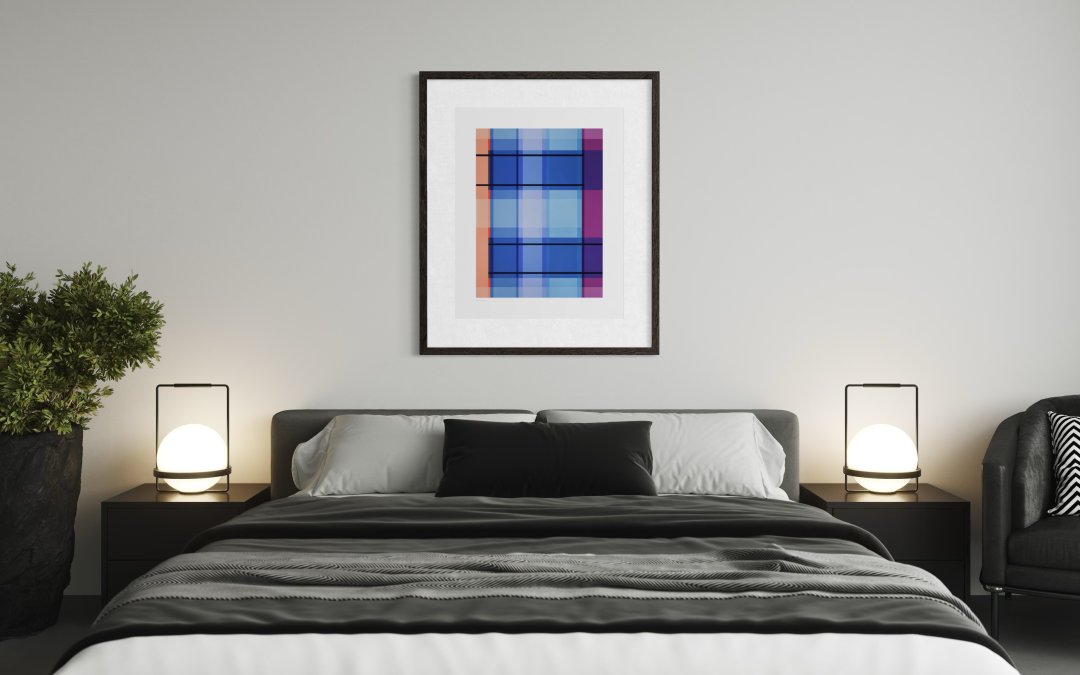
Start with these three decisions:
- Mat: Optional on our prints, since each ships with an intentional white border. A wider mat adds presence.
- Glazing: Acrylic with UV protection blocks the light that fades ink and costs less than glass.
- Hanging: Keep prints off direct sun and away from heat sources.
Matting, UV Protection, and Glazing Choices
UV-filtering glazing is the single highest-value upgrade you can make. It slows fading more than any other framing choice. Acrylic is lighter and safer than glass, especially above a sofa or bed.
Museum Quality Art Prints Under $350: What to Look For
Every print in our collection lands under $350, and each one is signed, archival, and shipped free. That price range is where the market gets confusing, so here is how the options compare.
| Size Options | Price | Best For | |
|---|---|---|---|
| Sacred Symmetry 1-4 | 16x16 to 24x24 in | $180 | Quiet, reflective spaces |
| Mountains & Shadows 3 | 16x16, 20x20 in | $180 | Smaller walls, first collectors |
| Mountains & Shadows 1 & 2 | 20x20, 24x24 in | $225 | Bold desert color |
| DoubleCross | 18x24, 24x30 in | $345 | Living rooms, coastal palettes |
| Prism Break | 24x30, 29x36 in | $345 | Statement focal points |
| Uptown Express | 24x30, 29x36 in | $345 | Offices, urban interiors |
Small Format Options Under $200
The Sacred Symmetry series and Mountains & Shadows 3 start at $180. The 16x16 Sacred Symmetry prints carry a 2.5-inch border around an 11-inch image, so they arrive ready to hang without a mat. For a small apartment, this is the smart entry point: less wall, less risk, same archival standard.

Authentication, Certificates, and Eco-Friendly Inks: What Smart Collectors Check
A certificate of authenticity is a signed document that verifies the artist, the edition, the materials, and the date of production, and it is the difference between a decoration and a collectible. Every print we sell includes one and is individually signed by the artist. But most buying guides stop there, and that is exactly where the useful information begins.
What a Real Certificate of Authenticity Should Contain
A certificate that only says "this is authentic" is worth nothing. A useful one is specific enough to be checked. Look for these fields:
- Artist name and signature. Hand-signed, not a printed signature block.
- Title and edition. The work's name and, for limited editions, the edition size and the specific number of your print (for example, 12 of 50).
- Medium and materials. The printer type, ink chemistry, and the exact paper brand and weight.
If a seller cannot produce those fields on request, treat the print as an open-edition reproduction regardless of what the listing says.
How to Verify a Print Is Genuinely Museum Quality
Verification is a paper trail, not a vibe. A few checks separate a documented print from a decorated one:
- Ask for the paper spec by name. "Archival paper" is not a spec. "Hahnemühle Photo Rag 308 gsm" is.
- Ask which ink set was used. Pigment, and ideally the printer family (for example, a 10- or 12-color pigment photo printer).
- Check the signature against the certificate. They should match, and the edition number should not exceed the stated edition size.
Eco-Friendly Inks and Sustainable Printing
Pigment inks are lower in volatile organic compounds than older solvent-based inks, and archival printing avoids the chemical coatings that shorten a print's life. That is the durability story most guides tell. The sustainability story is just as concrete:
- Water-based pigment inks. Modern giclée ink sets are water-based rather than solvent-based, which reduces the VOC load in the studio and in your home.
- Acid-free, lignin-free paper. Because the stock is designed to last, it does not need the plastic laminates or spray coatings that turn a print into mixed-material waste at end of life.
- Paper sourcing. Look for FSC-certified or similarly certified stock, which confirms the fiber came from responsibly managed forests.
None of these choices trade off against quality, they are the same choices that produce a print worth keeping.
Display Lighting: The Variable Most Buyers Ignore
UV glazing plus smart placement does more for longevity than any spray or coating. Two rules cover most situations:
- Keep prints out of direct sun. Even UV-filtering acrylic slows fading rather than stopping it; a south- or west-facing wall in full sun will still degrade a print over years.
- Rotate pieces off bright walls. If a print lives in a high-light spot, moving it every year or two spreads the exposure across the collection instead of concentrating it on one piece.
Conclusion: Building a Collection That Lasts
The hardest part of collecting is not finding affordable museum quality art prints, it is trusting that the print will look the same in a decade as it does today.
Mark Travers Artist LLC builds every print to that standard, with free shipping and custom commissions available for designers and businesses. Start with a single piece, or contact us to commission work tailored to your space.
Frequently Asked Questions
What makes an art print 'museum quality'?
Museum quality art prints meet four standards: archival-grade paper (acid-free, typically 300gsm or heavier), pigment-based inks rated for decades of fade resistance, high-resolution printing at 300 DPI or higher, and proper color accuracy verified against the original artwork. At Mark Travers Artist LLC, every museum print uses Epson Hot Press Bright White 330gsm paper with archival pigment inks, includes a Certificate of Authenticity, and is individually signed by the artist.
What is the difference between a giclée print and a standard art print?
A giclée print uses pigment-based inks and archival paper, producing color accuracy and longevity that standard prints cannot match. Standard art prints often rely on dye-based inks and thinner, acidic paper that yellows within a few years. Giclée print quality standards require a wide color gamut, high DPI resolution, and materials rated to resist fading for 100 years or more under proper display conditions.
How do I choose the right frame for museum quality art prints?
Use acid-free matting and UV-protective glazing to prevent fading. Mark Travers prints include an intentional white border that eliminates the need for a mat, though adding one can make the artwork feel more substantial. A thin white or natural wood frame keeps the focus on the art.
Are affordable museum quality art prints worth the investment?
Yes, when the materials justify the price. A $180 to $345 museum print from Mark Travers Artist LLC uses the same archival paper and pigment inks found in gallery editions, includes a signed Certificate of Authenticity, and ships free. That is a fraction of an original painting's cost while delivering comparable visual fidelity and longevity. For collectors building a personal collection or designers sourcing for clients, archival prints hold their appearance far longer than inexpensive poster alternatives.
How do I display art prints to prevent fading and damage?
Keep prints out of direct sunlight and away from heat sources. Rotate pieces every few months if they hang in bright rooms. Use UV-protective glazing or acrylic when framing, and avoid hanging art above radiators or in bathrooms where humidity fluctuates. For long-term storage, place prints between acid-free tissue in a flat portfolio. Following these steps preserves color fastness and paper integrity for decades.
