
October 2026
How to Curate a Personal Art Collection

Table of Contents
- Start With Personal Taste and a Curatorial Vision
- Research Artists, Galleries, and the Art Market
- How to Commission Custom Abstract Paintings
- Art Collection Management Best Practices
- How to Display Art in a Home Gallery
- Conservation, Care, and Ethical Collecting
- Frequently Asked Questions
Last Updated: October 5, 2026
Start With Personal Taste and a Curatorial Vision
Learning how to curate a personal art collection begins with a simple truth: the collection should reflect you, not the market. At Mark Travers Artist LLC, we have watched collectors build rooms that feel like home by starting with instinct rather than investment logic. A curatorial vision is the guiding idea that connects every piece you buy, whether that is a shared color palette, a recurring theme, or a single feeling you want your walls to evoke.
Define Your Collection Identity
Your collection identity is the thread that ties individual purchases into something coherent. Ask what draws your eye first: bold geometric shapes, quiet color fields, or the interplay of light and shadow. A collector who loves desert tones will build a different collection than one drawn to urban color. Neither is better. What matters is that the identity is yours.
Set a Budget and Collect Within Your Means
A common mistake is treating art as a single large purchase instead of a gradual practice. Set a monthly or quarterly figure you can spend without strain, then let that number guide your choices. Affordable prints make it possible to live with a piece before committing to a larger work. Our Meditations 1 gallery print, at $19, is an easy entry point for testing how a bold blue and teal composition sits in your space.

Research Artists, Galleries, and the Art Market
Research is what separates a collection from an accumulation. The goal is not to memorize the market; it is to build a repeatable habit of looking, comparing, and asking the right questions before money changes hands.
Start With the Artist, Not the Price
Read the artist's statement, then look at at least ten works across different years. You are checking for two things: a consistent point of view, and evidence of growth.
Ask the artist or gallery directly:
- What is the medium, and is it archival? (For works on paper, look for terms like archival pigment print, giclée on cotton rag, or lithograph.)
- Is this an original, a limited edition, or an open edition? If limited, what is the edition size and is this number still available?
- Is the work signed, and does it come with a certificate of authenticity?
A certificate of authenticity is not a legal guarantee of value, but it documents the artist, title, medium, dimensions, and edition number, which matters if you ever insure, lend, or resell the piece.
Read the Market Without Being Ruled by It
Pricing in the art market is not standardized the way retail is. Two works of similar size by similar artists can differ by thousands of dollars based on exhibition history, gallery representation, and demand. Useful reference points:
- Auction results (searchable through major auction house databases) show what comparable works actually sold for, not what they were listed at.
- Gallery and fair pricing reflects the primary market, where the artist and dealer set the price.
- Artist websites and print shops often sell editions directly, which can be more affordable than a gallery markup.
A practical rule many collectors use: never pay more for a work than you would be comfortable losing if it never resold. That keeps the decision about the art, not the return.
Where to Look
- Local galleries and nonprofit art centers, free to visit, and staff will often explain an artist's background.
- Museum exhibitions, the best free education in how works are hung, lit, and grouped.
- Art fairs, concentrated viewing, but high-pressure sales; go on the first day to look, not buy.
Buying From Emerging and Established Artists
Emerging artists offer discovery and accessible pricing. Established artists offer a documented body of work and steadier resale value. Most collections benefit from both, and the split is a personal choice rather than a rule.
| Stage | What to Look For | Typical Price Band |
|---|---|---|
| Emerging | Signed editions, small runs, clear artist statement, active studio practice | Entry level |
| Mid-career | Gallery representation, exhibition history, inclusion in group shows | Moderate |
| Established | Documented provenance, auction record, museum or institutional holdings | Higher |
When buying from an emerging artist, ask about the medium, edition size, and whether the work is signed. When buying from an established artist or secondary market, ask for the provenance in writing and confirm the work is not a reproduction unless it is sold as one.
A Repeatable Curation Framework
Competitors tend to treat research and buying as separate steps. A more useful approach is a short framework you run before every purchase:
- State the goal. What is this piece meant to do, anchor a wall, fill a gap in a theme, or introduce a new direction?
- Check the gap. Look at your existing inventory. Is there a size, palette, or subject you are missing?
- Test the fit. Would this work strengthen the collection if it were the only piece you bought this year?
- Verify the facts. Medium, edition, signature, certificate, provenance.
- Decide on a number. Set your maximum before you negotiate, and walk away if the seller exceeds it.
The framework does not require every piece to match. It requires that you can explain, in one sentence, why the work belongs.
How to Commission Custom Abstract Paintings
Commissioning is the most personal way to collect, and it is easier than most people expect. A commission starts with a conversation about your space, your palette, and the feeling you want the room to carry.
At Mark Travers Artist LLC, commissions are tailored to a specific environment, whether that is a living room, a hotel lobby, or an office reception wall.
Art Collection Management Best Practices
A collection needs a system, not just a wall. Good art collection management protects both the value and the pleasure of what you own. It also makes insurance, lending, and eventual resale far simpler.
Inventory, Documentation, and Insurance
Keep a simple record for every piece: artist, title, year, medium, dimensions, edition number, purchase date, price, and where it hangs. Store the receipt and certificate of authenticity alongside it. Photograph each work in place. Then speak with your insurer about whether your policy covers fine art, since standard homeowners coverage often caps it. Review the inventory once a year and update valuations as your collection grows.
- Record artist, title, year, and medium
- Note dimensions, edition, and purchase price
- File the certificate of authenticity and receipt
How to Display Art in a Home Gallery
Display is where a collection becomes a room. The most reliable starting point is to hang to eye level, the center of the artwork at roughly 57 to 60 inches from the floor, then build outward. From there, the decisions that matter most are layout, lighting, framing, and how the work relates to the furniture around it.
Layout: Pick a Method Before You Pick a Hammer
- Single focal point. One large work centered above a sofa, console, or bed. Best when the piece is the strongest in the room.
- Salon-style grid. Multiple works aligned to a shared centerline with consistent spacing (2 to 3 inches between frames). Works well on a large wall and lets you rotate pieces over time.
- Salon-style dense hang. Floor-to-ceiling coverage, historically used in European salons. High impact, but requires a strong unifying thread, palette, period, or subject, or it reads as clutter.
A practical spacing rule: keep the gap between frames smaller than the width of the narrowest frame in the group. That single constraint prevents the arrangement from looking scattered.
Lighting
Light does two things at once: it reveals the work, and it damages it. The balance is to light the art without exposing it to UV or heat.
- Avoid direct sunlight. UV exposure fades pigment over time, even in archival prints. South- and west-facing walls are the highest risk.
- Use LED or low-UV bulbs. They run cooler and emit far less UV than halogen or incandescent.
- Angle the light. Picture lights and track heads should sit above and slightly in front of the work, aimed at roughly 30 degrees so the light washes the surface rather than creating a hotspot.
Framing and Mounting
Framing is part of the artwork's long-term care, not just its look.
- Use archival materials. Acid-free mats, backing, and hinging tape prevent the paper from yellowing or staining.
- Mat or float. A mat creates breathing room and keeps the work off the glazing; a float mount shows the full sheet edge, which suits prints with deckled edges.
- Glazing choices. Standard glass is fine in low-traffic areas; acrylic is lighter and safer for large works; anti-reflective or UV-filtering glazing is worth the upgrade for anything valuable or sun-exposed.
Grouping by Theme, Palette, or Period
Group by color palette, subject, or period rather than by size alone. A wall of three works in the same palette family reads as intentional even when the sizes vary.
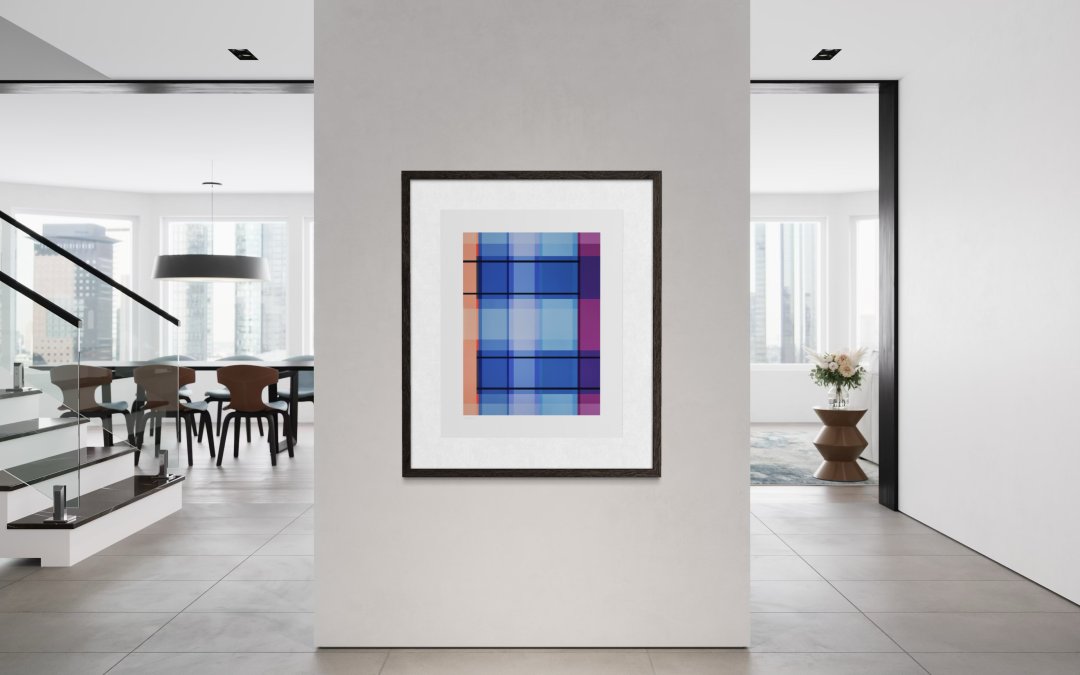
Our Sacred Symmetry 1 museum print, at $180, works as a single focal point above a sofa, while Mountains & Shadows 1 at $225 brings desert blues and greens into a quieter corner. For a larger statement wall, Prism Break at $345 commands attention in a hallway or office.


Rotate, Don't Retire
A collection is not static. Rotating works every six to twelve months, moving a piece from a hallway to a bedroom, or swapping a focal point, keeps the collection feeling alive and lets you live with works you already own before buying more. Store rotated pieces flat, wrapped in archival tissue or glassine, away from damp basements and hot attics.
Conservation, Care, and Ethical Collecting
Care keeps a collection alive for decades. Keep prints out of direct sunlight, since UV exposure fades pigment over time even in archival work.
Ethical collecting matters just as much. Pay artists fairly, respect edition sizes, and buy from sources that can document provenance.
Building a collection that still feels right in ten years is harder than buying art that looks good today.
Frequently Asked Questions
How do you start curating a personal art collection on a budget?
Start with a clear theme or color palette you love, then set a monthly or per-piece budget. Gallery prints and smaller works offer an accessible entry point; for example, Meditations 1 is a signed gallery print at $19.00, while museum-quality prints like Mountains & Shadows 1 start at $225.00. Buy one meaningful piece at a time rather than several impulse purchases. Prioritize works that fit your vision and that you would happily live with for years.
What defines a cohesive art collection?
A cohesive collection shares visual or conceptual threads, such as a recurring color palette, medium, theme, or art movement. It does not mean every piece looks identical. Instead, works should feel like they belong in conversation with one another. Deciding on a curatorial vision before you buy helps you evaluate whether a new artwork strengthens the whole or sits apart from it.
How do you balance personal taste with investment value in art?
Buy what you love first. Personal connection keeps a collection meaningful even if resale value fluctuates. If investment potential matters to you, research the artist's exhibition history, provenance, and edition sizes. Limited editions and signed prints with a certificate of authenticity tend to hold value better than open-edition reproductions. A balanced approach means every purchase satisfies your eye and your long-term goals.
What is the difference between collecting art and curating it?
Collecting is the act of acquiring artworks you enjoy. Curating is the deliberate process of selecting, organizing, and caring for those works so they form a coherent whole. A curator considers theme, placement, conservation, and how each piece relates to the others. You can collect without curating, but curating turns a group of purchases into a meaningful, intentional art collection.
How often should you rotate or update your personal art collection?
There is no fixed schedule, but many collectors rotate works seasonally or when they rearrange a room. Rotating pieces protects them from prolonged light exposure and keeps your space feeling fresh. It also gives you a chance to rediscover works you have not seen in a while. Keep a simple inventory so you always know what you own and where it is stored.
What are the best ways to display a curated art collection at home?
Group works by theme, color, or size to create visual rhythm. Hang at eye level, typically 57 to 60 inches from the floor to center. Leave enough space between frames so each piece breathes. Avoid direct sunlight and humid areas like bathrooms. Mixing sizes and orientations adds energy, but keep a consistent thread, such as matching frame styles or a shared palette, so the wall reads as one collection.
